We talk a fair bit about Burton’s brewing heritage, but what is it we’re actually referring to?

We talk a fair bit about Burton’s brewing heritage, but what is it we’re actually referring to?
There’s perhaps no one better to consult than author and Burton Ale Trail organiser Ian Webster, who has produced this handy guide to how a relatively small Midlands town became The Brewing Capital of the World.
1. The earliest reference to brewing in Burton upon Trent was in 1295, at the Benedictine Abbey.
2. In 1699, the Trent Navigation Act was passed, making Burton one of the countryʼs biggest navigation systems. The ports of Gainsborough, Hull and thereafter London – among other English and foreign ports – became accessible. Burton Ale could be sold to a wider market.
3. The first Common Brewer (one whose beer was not consumed on the premises) was Benjamin Printon, who founded a brewery in 1708. Today, the site is the car park of The Three Queens Hotel.
4. Other early brewers included William Newton, Samuel Sketchley and Joseph Smith.
5. Benjamin Wilson set up a brewery in 1742 at The Blue Stoops on High Street. This would later become Samuel Allsoppʼs Brewery.
6. William Worthington arrived in town in 1744. He worked as a Cooper for Thomas Salt until 1760, when he founded his brewery.
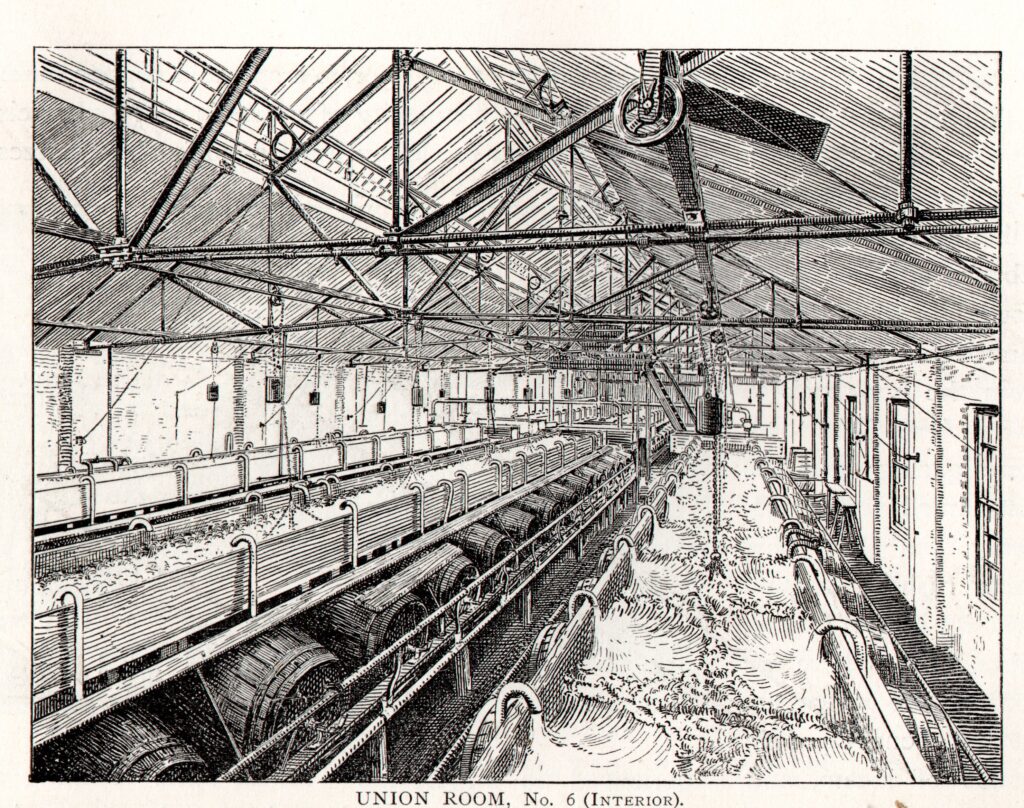
7. In 1777, William Bass also opened a brewery, having lived in Burton since around 1750.
8. Other notable brewers of the mid- to late-1700ʼs include John Musgrave, Charles Leeson, Joseph Clay, John Gretton and Thomas Robinson.
9. Burton Ale, described as dark, sweet and strong, was a notable export to the Baltic and was reputedly drunk by Catherine the Great of Russia.
10. In 1807, the Baltic Trade was wiped out almost overnight when Napoleon Bonaparte blockaded the Baltic ports. Many brewers went bankrupt as trading became very difficult.

11. In 1822 Samuel Allsopp was invited to London to dine with Campbell Marjoribanks of the East India Company, who were looking for a new brewer to provide beer for the empire in India.
12. Under the town are multiple layers of siltstone and mudstone, called the Keuper Maul, and below this is a thin layer of gypsum that imparts the minerals needed for hard water. Although not good for your kettle, it is perfectly suited for sparkling Pale Ales.
13. Legend says that an initial brew of the Indian beer was performed in a teapot by Allsopp and his Maltster Job Goodhead.
14. The first commercial brew of the Indian beer was in October 1822 and later that year 45 barrels were sent to Calcutta. There was a celebration to mark the bicentennial in 2022, attended by Jamie Allsopp, the seven-times grandson of Samuel. Jamie refounded Samuel Allsopp & Sons Ltd. in 2020. Although brewed in Leeds, Jamie wants to open his own Burton brewery.
15. India Pale Ale, as it is now known, was an instant hit and Bass, Salt and Worthington also began production.
16. By the 1830s, 6,000 barrels of India Pale Ale left Burton each year.
17. The home market soon developed a taste for India Pale Ale following the sales from a shipwreck off Liverpool, although this story is disputed by many historians.
18. Between 1828 and 1850, 15 new businesses were founded, including Burton Brewery Co. and John Marston, who opened a small brewery in Horninglow.
19. The railway came to the town in 1839 and opened up new markets. At this time, the town was making 60-70,000 barrels a year.
20. As the 1840s progressed, Bass and Allsopp reinvested profits and expanded. Bass Middle Yard was opened in 1842.
21. 1856 saw the first out-of-town brewer open premises in town – Romfordʼs Ind, Coope & Co.
22. These were followed by Manchesterʼs Henry Boddington and from London, Charrington & Head – as well as Truman, Hanbury & Buxton and Mann, Crossman & Paulin. Andrew Barclay Walker and Peter Walker came from Warrington and Everardʼs from Leicester.
23. Not all breweries were successful. Some of the short-lived businesses were Sarah Measom, Wylie Bros., John Youill and Dickenson & Co.
24. The expansion post-1851 was phenomenal. Allsoppʼs went from 80,000 barrels to 270,000 in 1861, they built a new brewery on Station Street, reaching a peak of 700,000 in 1875.
25. On 1 January 1876, Bass made history by registering the countryʼs first ever trademark – a label for their Pale Ale which contained the famous Red Triangle.
26. Although the Red Triangle is often referred to as the first trademark, this is inaccurate. The actual triangle was registered a few weeks later and is number 913.
27. By 1888, Burton was producing twice as many barrels as London and became The Brewing Capital of the World.
28. Legendary beer writer Alfred Barnard visited the town in 1888 and noted that 8,215 people were employed producing 3,000,000 barrels.
29. John Marston merged with John Thompson in 1898. They moved to their Albion Brewery premises on Shobnall Road later that year.
30. Between the late 1880s and late 1890s, many Burton brewers offered shares on the stock market. Some were a great success, others not so.
31. In February 1887, Samuel Allsopp & Sons were put up for sale at £3.3 million. It was a disaster and within three years the Chairman Samuel Charles Allsopp had resigned. By 1907, the Allsopp family lost control of the company.
32. Allsoppʼs Old Brewery was converted into the town’s first lager brewery in 1899. This was unsuccessful, but arguably ahead of its time.
33. Many of the brewers held important roles: William Henry Worthington was Burton’s first Mayor, a role George Allsopp also held. Henry Allsopp, Michael Arthur Bass, Henry Wardle (of Saltʼs) and Hamar Bass were MPs.
34. Michael Thomas Bass II paid for St. Paulʼs Church. Horninglow Church was partially funded by John Marston and John Gretton contributed towards Winshill Church.
35. The early 20th century saw a decline in the beer market. There were 24 brewers in 1900. By 1934, this had dropped to six as companies amalgamated or went out of business.
36. Ind Coope and Samuel Allsopp merged in 1934. Marston, Thompson & Evershed had been around since 1905 and Bass and Worthington came together in 1927.
37. Between 1935 and 1971, there were just five brewers: Bass (as either Bass Worthington, Bass Mitchells & Butlers or Bass Charrington), Allied Breweries (formerly Ind Coope & Allsopp), Marstonʼs, Trumanʼs and Everardʼs.
38. Following the foundation of the Museum Brewery at the Bass Museum in 1979, several smaller companies appeared, the longest lasting being Burton Bridge Brewery. Others include Heritage Brewing Co., Tollgate, Mundane, the Bevvied Bull, Old Cottage, Tower Brewery, Black Hole, Gates, G3, Outwoods and Burton Town.
39. Late 2022 saw both Burton Town close, as well as the National Brewery Centre. This left Heritage Brewing Co. without a home, until they started production at Burton Bridge Brewery. They would later buy the business in 2024.
40. Currently there are seven breweries: Molson Coors (who own what is left of Bass and Ind Coope), Carlsberg-Britvic (who bought out Marston’s in 2024), Tower Brewery, Gates Burton Brewery, G3, Outwoods and Burton Bridge, who are now the town’s longest running brewer. They celebrate their 45th anniversary next March!

Ian Webster is a Burton upon Trent brewing historian, author and creator of The Beertonian blog. He has published two books and is now writing The Brewers on the Bridge, the story of Burton Bridge Brewery, based on company archives and interviews with those who shaped its history. It will be published in Spring 2027.